

 Raja Hamza Asghar
In 2024, most Pakistani bloggers failed to build profitable blogs due to Google updates. From 2023 to 2024, Google changed its algorithm, and 90% of websites were affected by these updates.
Personally, seven of my successful blogs were hit by these updates, losing all their traffic from thousands to zero. However, you may be someone looking to restart your blogging journey.
Also, if you are a newbie and want to start blogging in 2026, then you need a proper roadmap. That’s why in this article I am sharing with you a successful roadmap to becoming a successful blogger in 2026.
SEO Roadmap: Start a Blog in Pakistan
If you want to build a successful blog then these are the steps you need to take.
- Find your niche
- Conduct keyword research
- On-page SEO
- Technical SEO
- Off-page SEO
- Branding for your site
Step 01: Find Niche for your blog
Choosing a niche is the first step you need to take. If you choose the right niche for your blog, it will likely succeed. However, choosing the wrong niche significantly increases the chances of failure.
From my 10+ years of experience creating multiple blogs, my final thought is to start your first blog within a niche you understand well, where you have experience and knowledge.
Right now I have strong knowledge of digital marketing, travel, crypto, and the share market. So if I want to build a blog, first I will focus on these niches to build blogs.
Because my experience and knowledge help me to build E.E.A.T easily. Which helps me to rank on Google very fast. That’s why I highly recommend you build your blog in those niches where you have experience.
But if you don’t have any topic to start with, then there are steps that you can take to find a profitable niche for your blog.

How to choose Niche for your blog
There are a lot of ways to choose the niche. But I am telling you those ways that I use to pick the niche for my blogs.
- Pre-knowledge
- Trends
- Through Competitors
- By SEO Tools
First, find the niches where you have knowledge and experience. But if you don’t have any, then these steps will help you to find niches.
The easiest method to pick a niche is to see the trends. Because a trending niche will increase the chances of success. Also, look out for your competitors and some news sites to get an idea about topics.
This leads you to a niche where you can start your first blog. But before you start, do a little more research to understand more about your niche. These are the two things that you need to research.
- Depth of Topics
- Monetization methods
1) Depth of Topics
First, assess the topic depth in your niche. For example, on my blog, Digital Hamza, my main niche is SEO. This niche has various sub-topics, such as keyword research, on-page SEO, off-page SEO, technical SEO, and local SEO.
Also, in my sub-topics, there are a lot of blog topics. This means my niche “SEO” has great depth in topics. So, like me, choose a niche where you have a lot of topics to cover.
2) Monetization methods
After checking your topic’s depth, the second thing that you need to consider is the monetization method. There are two main monetization methods.
The first one is ads. For ads, you need to check the CPC ( Cost per click ), because CPC tells you how much advertisers pay in your niche.
So high CPC means high income from blogs, and low CPC means low income from ads. For ads, there are a lot of ad networks that you can use, like Google AdSense, Mediavine, etc.
The second one is affiliate marketing. Affiliate marketing is a way to get money by promoting someone’s products. When someone buys them, you will get a commission.
There are many affiliate marketing platforms you can use, such as ClickBank, JVZoo, Commission Junction, and Awin.
Step 02: Keyword research for blogs
After finding a niche, the second step that you need to do is keyword research. Keyword research is the way to find profitable keywords for your blogs.
If you don’t know what keywords are, don’t worry, here is the definition of keywords. Keywords are the words or phrases someone searches on Google to find their results.
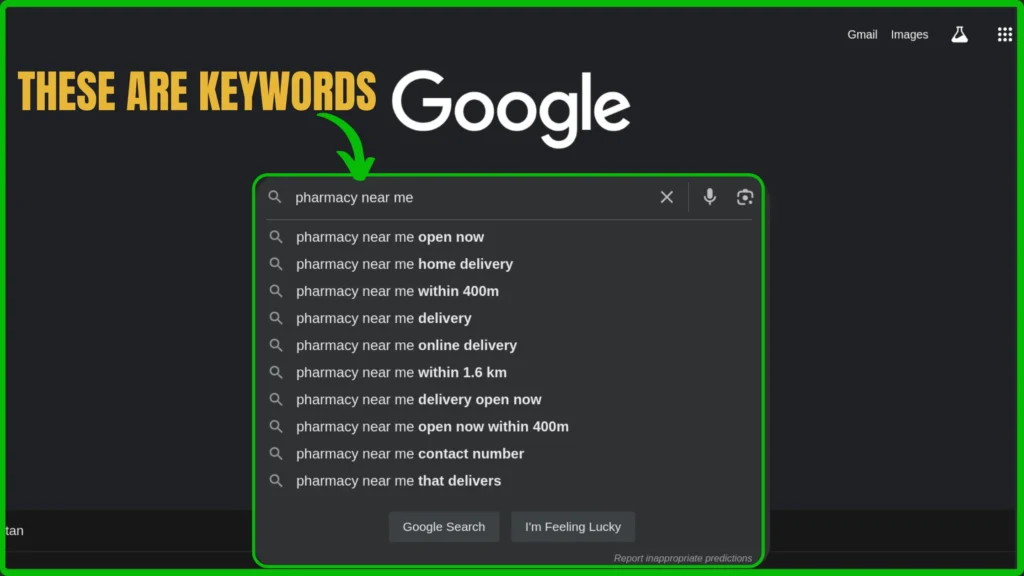
For me, keywords are the main component of your blogs. So for me, if I want to excel in SEO, then I need to master the art of finding the keywords.
How to find keywords for your blog
There are a lot of ways to find keywords for your blog. Every expert has their own strategies for finding keywords. Like them, here I am sharing with you my personal keyword research strategy, which helps me to find untapped low-competition keywords.
Before I tell you how to find keywords. Understand the important metrics of keywords.
- Volume: Volume is the estimated number that indicates how many people search for this keyword on average.
- KD: KD ( Keyword difficulty ) is a metric that shows you the competition of your keyword. A low KD means less competition, and a high KD means high competition.
- CPC ( Cost Per Click ): CPC is a metric that shows us how much an advertiser pays per click. If your niche has a high CPC, that means you earn a good amount of money.
1) AIW Strategy
For the last 4 years, I have been working with this AIW strategy, which helps me to find low-competition keywords.
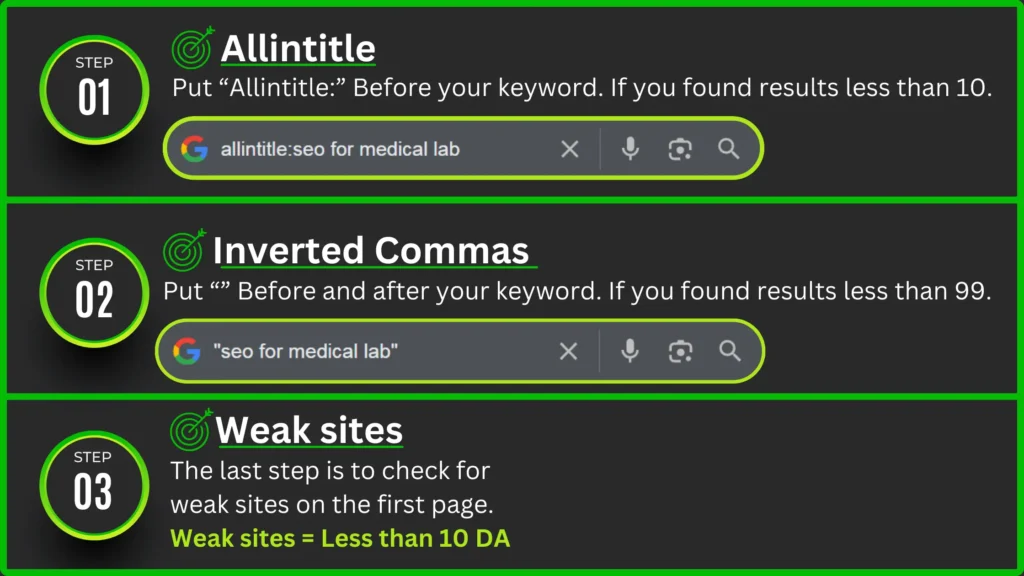
In this strategy, we are finding the three metrics by using Google. The first one is allintitle, which is an advanced search operator of Google. You just need to add ( allintitle: ) before your keywords, then search.
After searching, if you find less than 10 results, this means there is a chance to rank on this keyword as a new blog. The second metric is an inverted comma, which is also an advanced search operator.
You just need to add ( “ ” ) before and after your keyword, then search. If you find less than 99 results, then that keyword has a 50% chance to rank as soon as possible.
After finding these two things, you need to check weak sites. If there is any weak site ranking for this keyword, then you have found a keyword that ranks on Google very fast, if you write quality content on it and your blog has topical authority.
What are Weak Sites?
Weak sites are those sites that have less than 10 DA. To check if you found any weak sites, there are a lot of tools that you can use to find the DA of sites.
…………………………………
I already wrote a detailed article about AIW strategy. Go and read that article to understand how AIW works.
2) How to find keywords with tools
There are a lot of keyword tools that you can use to find keywords. For example, Ahrefs, Semrush, Ubersuggest, etc. Every tool has its own interface, but the core features are the same.
Every tool provides you with those important metrics that I already told you about, and these are the important ones. If you want to learn keyword research with tools, then I recommend you learn from my YouTube channel.
I already published a detailed course on keyword research. Just search “Keyword research course by Digital Hamza” and you will see that course. Learn keyword research from that course.
Step 03: On-page SEO
After finding keywords, the next step is to optimize your website for those keywords and perform on-page SEO. The process of SEO that we perform on our site to gain traffic is called on-page SEO. There are some steps that you need to do in on-page SEO.
1) Optimize Meta ( Title, Description and Tags )
In meta, you must add a title, description, and tags for your site and its pages. Meta is an important section of your website, so try to add your main keyword in the meta.
Because when crawlers come to your blog, the first thing that they crawl is the meta. So if you add your keywords in the meta, this will increase the chance of ranking.
2) Content Presentation
In 2026, for me, along with content writing, content presentation is the most important. If your content is impressive and does not irritate users, this will increase audience retention and decrease bounce rate.
That indicates to Google that your content has something that users love. If users love your content, you will get a higher ranking in the SERP. But if your presentation is not impressive, users leave your page.
This will increase your page’s bounce rate. That will indicate to Google that your content is not liked by users. If users do not like your content, the result is a drop in the SERP ranking.
3) Image optimization
Image optimization is one of the most important factors of on-page SEO. Because if you upload images in the wrong format, this will slow down your site. Most newbies upload images in PNG or JPG format, and mostly images in these formats have a large size.
This makes your page heavy, so when your page loads in the browser, it will take time. This irritates the users, so the chances are high that they leave your page and visit the next page.
That will increase the bounce rate, which leads to a drop in your ranking in the SERP. So when you upload your image to your site, the first step is to convert your image into WebP.
Second, rename your images with your keywords. The last one: after uploading your image, you must add ALT ( Alternative text ) to your image.
Alt text helps search engines to understand what images you have uploaded. A clear alt text will increase the chances of ranking your images in Google Images.
4) Internal & External Linking
Internal and external links are the next important thing. Because these links help search engines and users navigate through your site.
Internal links are the links to your pages that you add to your article, and external links are the links to other sites that you can add to your content to increase the authority of your content.
5) UX & UI
UX and UI do not directly impact your site’s SEO. But these two are important factors, which help Google to understand how users interact with your website.
If users like your UI and give time to your site, this gives your site a better ranking. But if the user does not interact with your site and skips your page. Then this will increase your bounce rate.
That gives a signal to Google that your site has something that users hate. So Google drops your ranking. Because Google wants to rank those sites that serve their users a better experience.
6) Content Structure
In content structure, you need to optimize your headings and paragraphs. There are six types of headings. You need to understand these six headings.
This will lead you to make the best structure for your blog posts and sites. So a clear structure helps Google to understand your site clearly.
7) Mobile Friendly Site
A responsive site will make users visit your site from mobile. If your site is not mobile-friendly, then this will irritate users. That increases your bounce rate, which impacts your site ranking.
So double-check your blog post and site responsiveness before publishing it. There are a lot of themes that come in WordPress that are already mobile-friendly and responsive, like Astra, GeneratePress, Divi, type, etc.
Step 04: Technical SEO
With on-page SEO, you need to perform technical SEO on your website. In technical SEO, we work on our site’s technical aspects like optimizing site speed, setting up tools, etc. These are some steps that you need to take:
1) Speed Optimization
Speed optimization is one of the most important parts of technical SEO. If your website loading time is more than 3 sec.
Then it will increase your website bounce rate, which directly affects your website ranking. There are some important factors you need to fix: Core Web Vitals, JavaScript errors, and server-related things.
2) Core Web Vitals
Core Web Vitals have three important components that you need to fix. Because if your site has bad Core Web Vitals, then it will impact your website speed.
The first component is LCP ( Largest Contentful Paint ), which measures the time to load large content on a website page.
The second one is CLS ( Cumulative Layout Shift ), which measures the page shift while it is loading.
The last one is INP ( Interaction to Next Paint ), which measures how much time the page needs to respond when users click or tap.
3) Make sitemap and robots.txt file
A sitemap is the file with all your website’s links that helps crawlers to read your website, and the robots.txt file is a code that we can use to configure how crawlers interact with sites.
If you are using WordPress then there are a lot of SEO plugins that will generate sitemap and robots.txt files for your website, like Rank Math, All in One SEO, Yoast, etc.
4) Set up Google Search Console and Analytics
Google Search Console is a tool that we use to tell Google about our site. Every search engine has its own webmaster tools, which crawl sites to index them on search engines.
Google has its Google Search Console. When we submit sites in Search Console, Google sends its crawlers to read the content on our site.
5) Fix Broken Links
Sometimes you delete a page of your website but do not remove its link from search engines. So at that time, if someone visits your page, it shows a 404 error.
These are called broken links. To fix them first you need to remove that page from search engines and then redirect it to your site’s other page.
6) Redirections
When you find any broken link on your site, there are tools that we can use to redirect it. If you are using WordPress, then Rank Math will help you to redirect it.
Step 05: Off-page SEO
After on-page and technical SEO, the last step is off-page SEO. In off-page SEO, you need to build the authority of your website. Focus on content marketing and also work on the branding of your site.
1) Backlinking for your site
Backlinks are the main component of off-page SEO. Backlinks are the links that we give to anyone or get from anyone’s sites.
Google does not openly say backlinks are important. But with experience and knowledge, I say backlinks are important.
There are many types of backlinks. But the important backlinks are those backlinks.
That you get from the body content of other sites. In short, you need to build guest post backlinks. In guest posts, you need to write an article that you will publish on those sites from where you need to get backlinks.
Step 06: Build branding for your site
Branding is the most important thing in 2026 if you want to rank on Google. Now Google does not see the content only. Along with content, Google considers the branding of the website and the author who publishes content on it.
In fact, there are a lot of benefits that you get after building the site’s branding. The first one that I see is that branded sites do not get hit by Google updates. The second one is Google’s trust. Sites like Neil Patel, Ahrefs, and Backlinko have the trust of Google.
So when these websites publish any article in their niche, Google immediately ranks it in the top positions because of branding and trust.
Digital Hamza personal SEO Plan for 2026
In 2026, I do not only focus on the traditional SEO plan that I already told you about in this article. Along with these SEO steps, I now focus on other stuff. After the changes in the Google algorithm, these are the important factors that you also need to consider.
- Focus on E.E.A.T
- Build Topical Authority
- Build Branded Searches
- Social media content for branded searches
1. Focus on E.E.A.T
E.E.A.T is the factor that most Pakistanis ignore, because they don’t know how it will help their blogs to rank on Google in 2026. E.E.A.T has four components.
- E ( Experience )
- E ( Expertise )
- A ( Authoritativeness )
- T ( Trustworthiness )
These are the components of E.E.A.T. Let me explain to you what it is. If you search on Google for the definition of E.E.A.T, then you get a fancy definition.
But I will tell you the simple definition. For me, this is the metric that is used to evaluate the experience and knowledge of the author who writes content on the blog.
So now, in 2026, start your blog in that niche where you have knowledge and experience. This will easily build your E.E.A.T, which leads you to rank on Google for the long term.
2. Build Topical Authority
Topical authority is one of the most important factors of my SEO strategy for 2026, because this will help me to rank on Google very fast. Topical authority is a weapon against high DA general sites.
In topical authority, we focus on topics rather than keywords. Because while covering topics, we share our experience and knowledge. This will build E.E.A.T very fast, and E.E.A.T is a metric to establish experience and authority for Google.
For example, if I want to rank for “SEO for medical lab”, it’s impossible to rank on this keyword with just a single article. So for ranking, I need to cover SEO-related stuff for the healthcare sector.
This will show my knowledge and my experience to Google for healthcare. So after building topical authority, I ranked for SEO for healthcare-related queries very fast.
3. Social Media Content for Branded Searches
Branded searches are the next thing that I consider in my 2026 SEO strategy. A branded search is when someone searches for your brand name on Google.
This will show Google that this blog has some authority and audience. There are some strategies that I use to build branded searches.
But one of the best strategies is social media content. Because this is one of the fastest and best methods to build credibility all over the internet as an author. Also, branded searches will help to build E.E.A.T very fast.
That’s why most of the experienced SEOs make content on social media, like Neil Patel, Brian Dean, Nathan Gotch, Matt Diggity, etc.
Final Thought
If you want to start your blog in 2026, along with traditional SEO you must focus on my plan to stay relevant for the long term. Also, I am giving you some tips to help you grow fast.
Start blogging in that niche where you have your own experience and knowledge. But if you don’t have any, pick a niche in which you have an interest.
Then give time to that niche and learn everything about that niche, from basics to advanced. Also, if possible, try to implement those things to gain experience and expertise in it.
Because in 2026 blogging is a game of experience and knowledge. The reason is Google updates. Every year Google brings eight to nine updates, which affect those blogs that work on low-quality content. So gain knowledge and then start. Otherwise, there are a lot of other ways to earn money online.
For now, it’s the end from my side. I hope you learned from this post. If you have any questions, feel free to contact me on social media @digitalhamza.
Thanks for reading, Regards Digital Hamza.